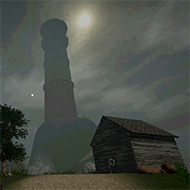
You start In Out Here with a radio, a map, and a voice on the other end that’s already panicking before you’ve even said a word back. A fisherman is out there somewhere in the dark, something surfaced near his boat, and every other lighthouse along the coast has already gone dark. Yours hasn’t — yet — and guiding him home before that changes is the entire game.
| Genre |
First-person survival horror |
| Core Mechanic |
Radio-guided navigation from a lighthouse vantage point |
| Setting |
A single lighthouse and the dark water surrounding it |
Guiding the Fisherman in Out Here
The core mechanic in Out Here is deceptively simple to explain and genuinely tense to execute: you’re stationed at the top of a lighthouse with a map and a line of radio contact to a fisherman who’s lost his bearings after something emerged from the water near his boat. Using your elevated vantage point, you have to read the surrounding darkness, cross-reference it against the map, and talk him through a route back to safety, all while every other lighthouse that should be helping has already gone dark.
That radio connection is the whole tension engine. You can’t act directly on his behalf — you can only describe what you’re seeing and trust that your directions land correctly, which puts real weight on careful observation rather than reflexes. A wrong read of the map, or a misjudged direction called out too quickly, can send him further into danger instead of away from it.
The game builds its horror almost entirely through that helplessness — being the one person who can see the bigger picture, and still not being able to guarantee the outcome, is a different kind of dread than a jump-scare-driven chase sequence, and it’s what set Out Here apart when it first appeared as a Scream Jam submission.
Directions That Cost the Fisherman Time
New players tend to rush their directions, calling out routes before fully confirming what the map and the visible darkness actually show. Because the fisherman is relying entirely on your read of the situation, a hasty or unclear direction can cost more time — and more danger — than taking an extra few seconds to actually verify the route first would have.
The second common mistake is treating the lighthouse’s vantage point as a passive viewing tool rather than an active one. Out Here rewards players who actively scan and reposition their attention across the water rather than fixating on one spot, since whatever surfaced out there with the fisherman doesn’t stay conveniently in view the whole time.
Players also tend to underestimate how much the darkened neighboring lighthouses matter narratively and mechanically — their absence isn’t just atmosphere, it’s a signal about what’s already happened nearby and what might be coming for yours next.
How the Tension Builds
Early in a run, the radio contact is calm enough to let you get comfortable with the map-reading mechanic before anything actively threatens the fisherman’s route. As the situation develops, his panic increases, the directions get harder to call cleanly under pressure, and the darkness around the boat starts concealing more than it reveals.
By the time you’re deep into guiding him back, every choice feels weighted in a way the opening minutes didn’t prepare you for, and that escalation — from a manageable rescue to a genuinely uncertain one — is where Out Here earns its reputation as tighter and more effective than its short runtime might suggest.
Multiple Endings and What Players Debate
Out Here doesn’t resolve the same way every time, and the branching outcomes depending on how the guidance goes are a big part of why players return to it more than once. Comparing notes on which specific calls led to which ending has become a common thread in community discussion around the game.
What players tend to disagree on is whether the short runtime undersells the concept or is exactly the right length for it. Fans of tight, single-sitting horror argue the brevity keeps the tension from diluting; others wish the radio-guidance mechanic had more room to develop before the game reaches its conclusion. Both are reasonable reactions to a game built around one focused idea rather than a sprawling system.
Answering the Most Common Questions About Out Here
- Can you actually fail to save the fisherman in Out Here? Yes — the branching endings depend directly on how accurately and quickly you guide him, and a poor read of the map or a late direction can lead to an outcome where he doesn’t make it back.
- Do the other darkened lighthouses ever play a direct role, or are they just atmosphere? They function as both — their absence sets the tone, but their state also signals what’s already happened along the coast and hints at the danger your own lighthouse may eventually share.
- How long does a single playthrough of Out Here take? It’s built as a short, focused horror experience rather than a long campaign, which is part of why players often replay it to see how different guidance choices change the ending.
By the time the radio finally goes quiet in Out Here — one way or another — what stays with you isn’t a jump scare, it’s the memory of every direction you called out into the dark, unsure until the very end whether any of them actually helped. Few games built this small manage to make helplessness feel this deliberately, effectively earned.