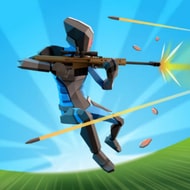
Stand still in Time Shooter 2 and the world around you slows to a crawl — bullets hang in the air, enemies inch forward like they’re wading through syrup, and you get all the time you need to plan your next move. Move, and everything speeds back up in exact proportion to how much you moved. That single rule is the entire game, and it turns every room into a puzzle disguised as a shootout: the danger isn’t reflexes, it’s whether you can read a frozen moment correctly before you commit to breaking it.
| Genre |
First-person time-manipulation shooter |
| Core mechanic |
Time moves only when you move |
| Weapons |
Pistols, machine guns, shotguns, pickaxes, throwables |
| Visual style |
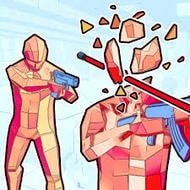
Minimalist low-poly, white and blue environments, orange enemies |
| Platform |
Browser |
Time Shooter 2 belongs to the small but distinctive family of games built around SUPERHOT’s central idea — time as a resource tied directly to your own movement — and it commits fully to that premise rather than treating it as a gimmick layered on top of a conventional shooter. Every encounter becomes a question of sequencing: which threat do you neutralize first, how much do you need to move to line up a shot, and how do you avoid over-committing into a burst of real-time danger you haven’t accounted for yet.
The Core Mechanic: Movement as the Only Clock
There’s no pause button in Time Shooter 2 and there doesn’t need to be one — standing completely still is effectively a soft pause already, since enemies and projectiles crawl forward at a fraction of their normal speed. The instant you move, even slightly, time accelerates in direct proportion. A small side-step buys you a small window to react; a full sprint across a room throws everything back to near-normal speed, bullets included.
That proportional relationship is what gives the game its puzzle-like feel despite being framed as an action shooter. You’re not just reacting to threats, you’re calculating how much time a given action is going to cost you before you commit to it — a tiny flick of the wrist to fire a shot moves time forward barely at all, while diving across a room to reach a weapon exposes you to nearly full-speed danger for as long as that movement takes.
Reading a Frozen Room Before You Break It
The skill Time Shooter 2 is actually testing isn’t reflexes in the traditional shooter sense — it’s spatial reading. Because you can effectively freeze the room by holding still, you’re given time most shooters never offer: a chance to survey exactly where every enemy and every incoming projectile is before deciding your next move. Players who rush into rooms without pausing to read the layout tend to walk directly into bullets they had every opportunity to see coming.
This reframes what a “mistake” looks like in the game. You’re rarely killed by something you didn’t see — you’re killed by moving through a frozen scene without accounting for what your own movement was about to set back into motion. That distinction is the entire skill ceiling of Time Shooter 2, and it’s why players who treat it as a pure twitch shooter tend to bounce off it faster than players who treat it as a positioning puzzle first.
The Weapon Roster and How Each One Changes the Puzzle
Time Shooter 2 gives you a genuinely varied toolkit — pistols for precise, low-commitment shots, machine guns for clearing multiple threats at once at the cost of more sustained movement, shotguns for close-range certainty, throwables for hitting something without exposing yourself to a direct line of fire, and even melee options like pickaxes for silent, zero-time-cost eliminations when an enemy is close enough.
Each weapon effectively changes the shape of the puzzle a room presents. A pickaxe swing at an adjacent enemy costs almost no time acceleration, making it the safest option when you can reach a target directly. A thrown weapon lets you deal with something across the room without needing to expose yourself by aiming a gun in the open. Machine guns trade the safety of small, precise movement for the ability to handle several enemies in the same accelerated window. Learning which tool fits which situation is as much a part of mastering the game as the movement-timing itself.
Pistols: The Default, Low-Commitment Option
A pistol shot barely nudges time forward, which makes it the safest default weapon whenever precision matters more than speed. Most rooms in Time Shooter 2 can be cleared methodically with a pistol alone if you’re willing to take the slower, more careful route through them.
Shotguns and the Value of Getting Close
Closing distance is inherently risky since it means sustained movement and therefore sustained time acceleration, but a shotgun rewards that risk with close-range reliability that a pistol can’t match at the same range. Knowing when a room is safe enough to close that distance is a judgment call the game keeps testing throughout.
Pickaxes and Melee as the Silent Option
Melee kills in Time Shooter 2 cost almost nothing in terms of time acceleration compared to firing a gun, which makes a pickaxe swing the single most efficient way to remove a threat that’s already within arm’s reach — provided you can get there without triggering everything else in the room first.
The Minimalist Visual Language and Why It Works
The low-poly, high-contrast look — white and blue environments, orange enemies, black weapons — isn’t just an aesthetic choice, it’s functional. In a game where reading a frozen scene correctly is the whole point, a cluttered or realistic art style would work against the core mechanic. The stripped-down palette makes threats instantly legible against the environment, which matters enormously when your entire strategy depends on accurately scanning a room while time is nearly stopped.
What Players Debate About Time Shooter 2
The most common conversation around the game is inevitably the comparison to SUPERHOT, since the core mechanic is so directly inspired by it. Some players see that as a limitation — a browser-scale riff on an idea popularized elsewhere — while others point out that Time Shooter 2 executes the concept cleanly enough, with a genuinely varied weapon roster, that the comparison isn’t a knock against it so much as an acknowledgment of the lineage it’s working in.
- Standing completely still is the closest thing to a pause button the game offers, and it’s the single most important habit to build early.
- Weapon choice directly affects how much “time cost” a given kill requires — melee and thrown weapons are consistently the most time-efficient options when they’re usable.
- Rushing through a room without reading it first is the single most common way new players die, far more than any individual enemy being unfair.
Is Time Shooter 2 Actually About Reflexes?
Less than it appears to be. Because movement is what drives time forward, the game is closer to a spatial puzzle solved under a self-imposed clock than a traditional twitch shooter — the players who do best are reading rooms carefully, not reacting fast.
What’s the Fastest Way to Get Better at Time Shooter 2?
Deliberately practicing stillness — resisting the urge to move constantly and instead using held positions to fully read a room before committing to any action — improves results faster than trying to build faster reflexes, since the entire system is built around rewarding patience over speed.
Time Shooter 2 takes a mechanic that could easily have been a shallow gimmick and builds an entire skill ceiling around it — reading rooms, choosing the right tool for each threat, and understanding that the real enemy is never the orange figure in front of you, it’s the momentum your own movement is about to unleash.